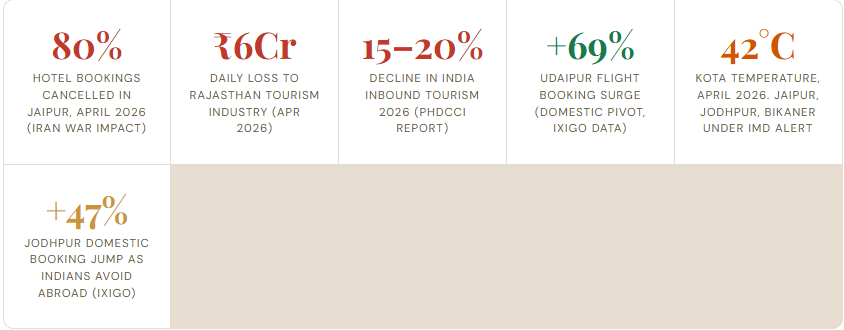
Rajasthan — India’s crown jewel of heritage tourism — is navigating one of its toughest seasons in recent memory. The US-Iran War (Operation Epic Fury, Feb 28, 2026) has disrupted global aviation, slashed foreign arrivals, and caused 80% hotel booking cancellations across Jaipur. Simultaneously, a record early heatwave in April 2026 is scorching the state, with Kota touching 42°C and Jaipur, Jodhpur and Bikaner all under IMD heatwave alert. Here is the complete picture — data, stats, and what to do next
The US-Iran War 2026: How a Middle East Conflict Is Destroying Rajasthan’s Foreign Tourism
On February 28, 2026, the United States and Israel launched surprise airstrikes on Iran — codenamed Operation Epic Fury — targeting military sites and assassinating senior Iranian leadership including Supreme Leader Ali Khamenei. Iran retaliated with drone and missile strikes across the Gulf, closed the Strait of Hormuz, and triggered the biggest aviation crisis since 9/11. Within hours, Dubai International Airport — the world’s busiest transit hub for Indian tourists — was damaged and shut down. Over 20,000 flights were grounded globally.
For Rajasthan, the fallout was immediate and devastating. Tourists from the US, UK, Germany, France, Australia, and Norway — who make up the bulk of Rajasthan’s foreign visitors — either cancelled trips or were unable to fly. Flight routes from Europe to India transit through Gulf hubs. When those hubs went dark, Rajasthan’s peak post-winter season was wiped out overnight.
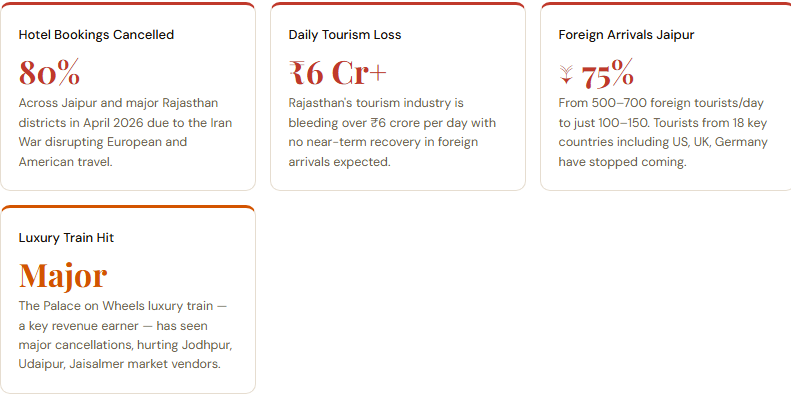
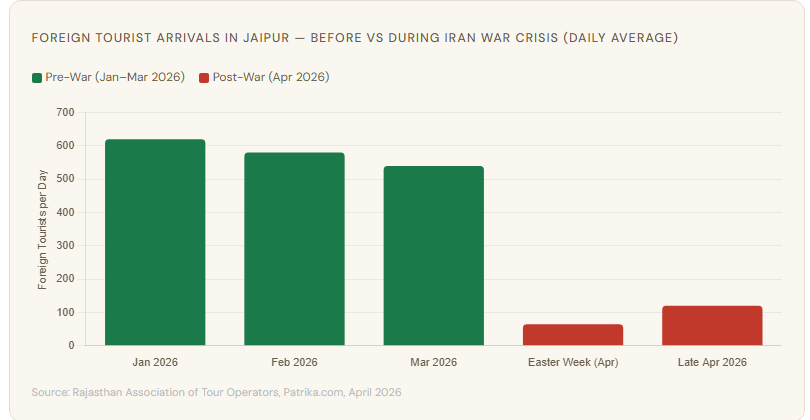
Mahendra Singh, President of the Rajasthan Association of Tour Operators, reported that hotels in Jaipur didn’t even receive 10% of expected foreign bookings for Easter 2026 — a period when Rajasthan is normally fully booked. Instead of the usual 500–700 foreign tourists arriving in Jaipur daily, the number dropped to just 100–150 per day. A daily loss of over ₹6 crore to the tourism industry has been reported.
“Approximately 80% of hotel bookings in Jaipur and other districts have been cancelled. The hotel industry anticipates losses amounting to crores by June. The current situation is causing a daily loss of over ₹6 crore to the tourism industry.”
— Patrika.com, Rajasthan Tourism Crisis Report, April 2026
| Company / Segment | Type | Impact in 2026 | Status |
|---|---|---|---|
| MakeMyTrip | OTA / Bookings | 15–20% ME & Europe bookings cancelled; Domestic pivot to Udaipur, Jodhpur | Mixed |
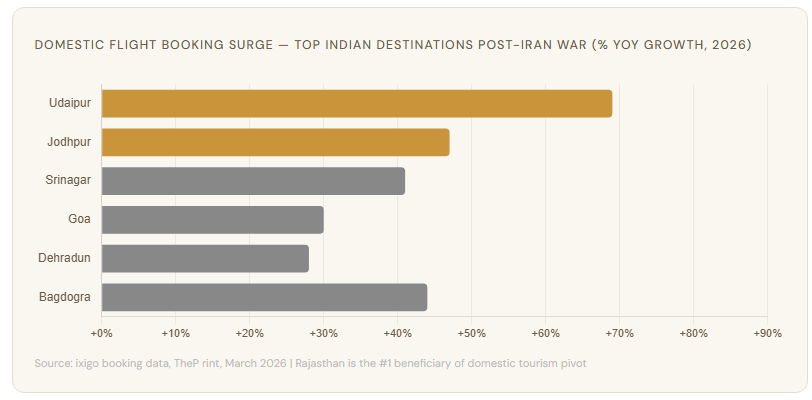
| ixigo | Travel Platform | Domestic leisure surges — Udaipur +69%, Jodhpur +47% YoY flight bookings | Benefiting |
| Rajasthan Heritage Hotels | Luxury Hospitality | 80% cancellations in April; Easter bookings < 10% of expected | Severe |
| Palace on Wheels (RTDC) | Luxury Train Tourism | Major booking decline; foreign dignitaries stopped travelling | Severe |
| SNVA Travel / Travomint | Tour Operators | Behavioural pivot — clients moving from Middle East/Europe to domestic | Adjusting |
| Heritage Cabs (Jaipur) | Car Rental / Tours | Foreign inbound declined sharply; strong domestic demand from Gujarat, Maharashtra, Delhi offsetting losses | Holding |
| Local Guides & Vendors | Informal Economy | Merchants in Jodhpur, Udaipur, Jaisalmer report significant drop in sales | Critical |
| Savaari / Zoomcar | Self-Drive Rental | Domestic road-trip demand rising; offset from cancelled international trips | Growing |
The PHDCCI (PHD Chamber of Commerce and Industry) released a report in April 2026 confirming that Indian carriers, which previously operated 300–350 flights a day to the Middle East, have been flying just 80–90 since hostilities erupted — meaning over 10,000 cancelled flights since February 28. India’s inbound tourism is projected to decline by up to 20% overall in 2026, with leisure travel from Europe and North America bearing the heaviest impact.
However, there is a silver lining that directly benefits Rajasthan’s domestic car rental and road-trip market: Indians who were planning holidays to Dubai, Europe, and the US are now choosing domestic destinations instead. This is the single biggest opportunity for Rajasthan’s tourism industry right now.
India Heatwave 2026: 95 of World’s 100 Hottest Cities Are in India — What It Means for Rajasthan Tourism
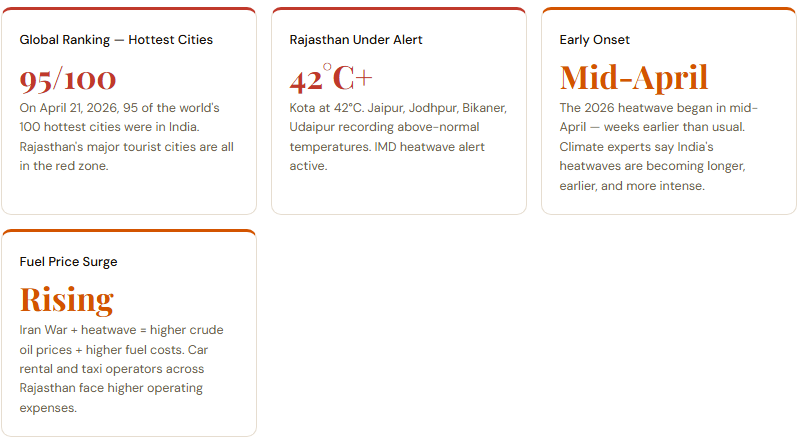
Even as the geopolitical storm rages, Rajasthan is battling a second front — the 2026 Indian heatwave. According to the India Meteorological Department (IMD), Rajasthan, along with Bihar, Delhi, Haryana, Punjab, UP, Madhya Pradesh, and Chhattisgarh, is currently under an active heatwave alert as of April 26, 2026. Kota has hit 42°C, and cities like Jaipur, Udaipur, Jodhpur, and Bikaner are recording above-normal temperatures. Hanumangarh, Sri Ganganagar, Jhunjhunu, Bharatpur, and Dholpur are under specific district-level heatwave warnings.
More alarming: on April 21, 2026, data from AQI.in showed that 19 out of the 20 hottest cities in the entire world were in India. This early onset of extreme heat — hitting weeks before the usual May peak — has tourism planners scrambling. The 2026 summer is forecast to be worse than 2024, which itself was a record year. IMD expects above-normal heatwave conditions across India through April to June 2026.
For tourism, the psychological impact of these headlines is often worse than the physical heat itself. When families see India topping global heat charts and read about heatwave deaths, they simply postpone. Schools in districts like Jaipur, Kota, and Jaisalmer have already shifted timings to 7:30 AM. Streets are deserted during afternoon hours. The outdoor tourism experience — desert safaris, fort walks, city sightseeing — becomes genuinely difficult between 11 AM and 5 PM.
“Delhi-NCR crossed 42.8°C on April 26 — 5.1 degrees above normal. 95 of the world’s 100 hottest cities were in India. Rajasthan’s Kota, Jaipur, Udaipur, Jodhpur and Bikaner are all experiencing hotter-than-usual conditions.”
— Business Standard / PTC News / IMD, April 26, 2026
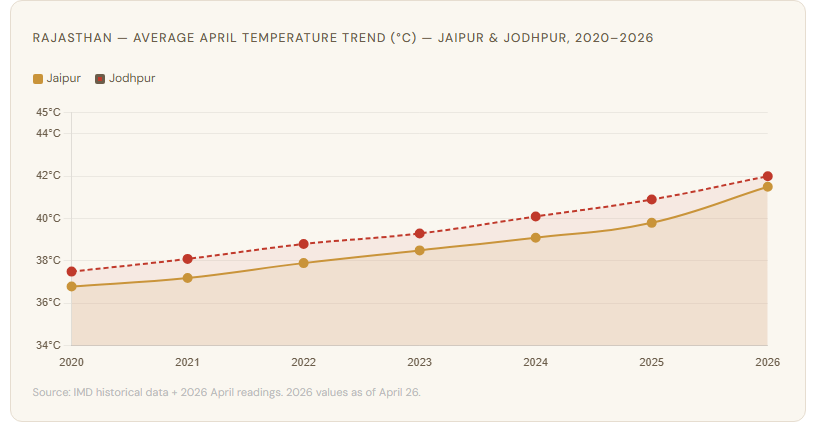

The heatwave does create an indirect tourism opportunity for the car rental sector. When walking and public transport become unbearable, air-conditioned private car rentals become the only comfortable way to explore. Tourists who do visit Rajasthan during summer are not going to walk Jaipur’s bazaars at noon — they need comfortable, AC cab services for point-to-point transfers, early morning departures, and sunset sightseeing. This is exactly where Heritage Cabs’ well-maintained, air-conditioned fleet becomes essential.
India Car Rental Industry in 2026: Who’s Down, Who’s Up, and What the Numbers Say
The India car rental market was valued at ₹25,900 crore (~$3.14 billion) in 2025 and was projected to grow at a CAGR of 12–14.5% through 2035. Tourism accounts for 58.33% of the total car rental market demand in India, making it deeply vulnerable to tourism shocks. The Iran War and heatwave have created a two-speed market in 2026: international-focused companies are bleeding while domestic-focused operators are holding or growing.
North India dominates the car rental market — home to the Golden Triangle (Delhi-Agra-Jaipur), Rajasthan, and Uttarakhand, this region drives the highest demand. Rajasthan alone received over 23 crore domestic tourists and 20 lakh foreign tourists in 2024, with Udaipur witnessing overseas traffic more than doubling (2.13 lakh to 4.83 lakh). Those foreign numbers are the ones now collapsing in 2026.
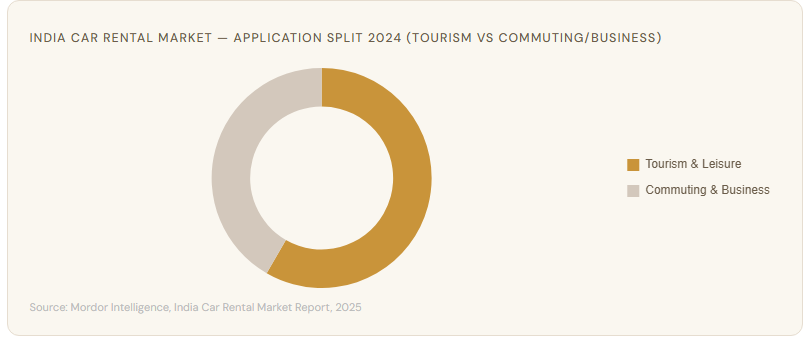
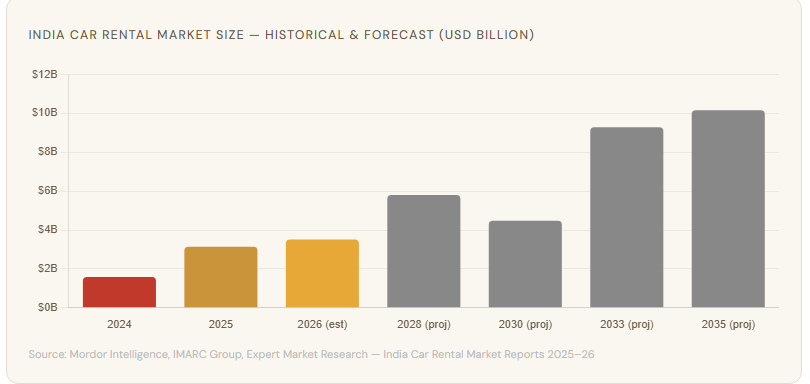
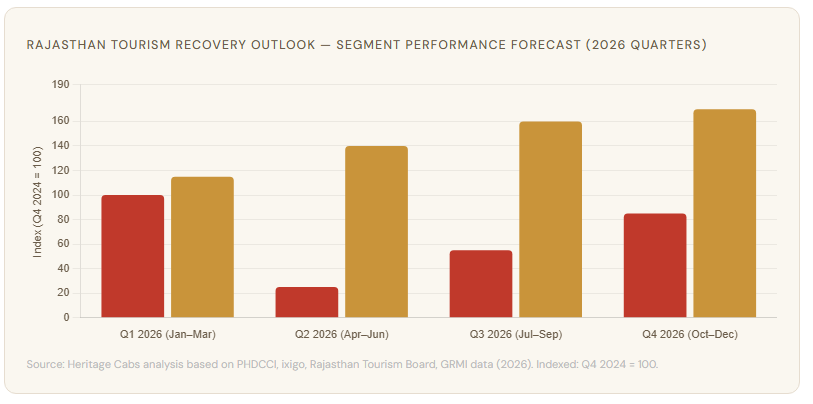
The key insight for 2026: while international tourism-dependent operators (high-end heritage hotel transfers, airport pickups from Gulf-transit flights, luxury train excursions) are suffering sharp revenue declines, domestic-focused car rental services are actually seeing a surge. Indian families who cancelled Dubai and Europe holidays are choosing Udaipur, Jodhpur, Ranthambore, and Jaipur instead — and they need AC cabs for the entire journey.
Online bookings now control 67.44% of the Indian car rental market and are growing at 7.87% CAGR. Economy/budget cars dominate at 72.55% market share. Short-term rentals lead at 69.46%. These figures point to exactly the kind of domestic, value-seeking traveller who is now flooding into Rajasthan — and who needs a reliable, transparent, online-bookable car rental service.
| Segment / Metric | 2024–25 Figure | 2026 Direction | Trend |
|---|---|---|---|
| India Car Rental Market Size | $3.14 Billion (2025) | Growing despite shocks | ↑ Positive |
| Tourism Share of Car Rentals | 58.33% | Shifting: domestic up, foreign down | → Mixed |
| Online Booking Share | 67.44% | Accelerating post-war (safety + flexibility) | ↑ Rising |
| International Inbound Rentals (Rajasthan) | Strong 2024 | Down 75%+ in April 2026 | ↓ Severe |
| Domestic Leisure Rentals (Rajasthan) | Base strong | Surging — Udaipur +69%, Jodhpur +47% | ↑ Surge |
| Self-Drive Segment Growth | 8.13% CAGR | Fastest growing — millennials, road-trips | ↑ Fast |
| Fuel / Operating Costs | Moderate 2024 | Rising — Iran War → crude oil surge | ↑ Pressure |
| AC Vehicle Demand (Heat Season) | Seasonal | Critical — only comfortable travel option | ↑ Essential |
What Should Rajasthan’s Tourism & Car Rental Businesses Do Right Now?
The global crises of 2026 are not going away overnight. A ceasefire between the US and Iran was announced in early April, but travel confidence from Western markets will take months to rebuild. The heatwave will intensify through May–June before monsoon provides relief. Smart tourism operators must adapt their strategy immediately. Here is a practical, data-backed roadmap:
🇮🇳 Aggressively Target the Domestic PivotIndians who cancelled Middle East and Europe holidays are actively looking for domestic alternatives. Udaipur is seeing +69% and Jodhpur +47% flight booking surges right now. Run targeted digital campaigns on Google and Instagram for “Rajasthan summer travel,” “Jaipur weekend trip,” and “Rajasthan road trip 2026” — the audience is searching actively.
🌞 Build Heat-Friendly Tour PackagesDesign tours around the heatwave, not against it. Offer early morning sunrise fort walks, late evening city drives, and sunset camel safaris. Position your AC cab service as the only comfortable way to sightsee in 40°C+ temperatures. A “Cool Rajasthan” package (early morning departure, mid-day hotel rest, sunset drive) is the perfect summer product.
📱 Go All-In on Online Booking & Flexible Cancellation67% of car rental bookings in India happen online. Travellers in 2026 are booking closer to their travel date and want easy cancellation policies given global uncertainty. Make your online booking seamless, offer WhatsApp-based booking, and provide a no-questions-asked 24-hour cancellation policy to capture last-minute domestic travellers.
✈️ Target Returning NRIs and Indians Repatriated from the GulfThe Iran War has resulted in hundreds of thousands of Indian nationals being repatriated from the Middle East, with a 14% growth in Indians returning home long-term. These returnees have savings, travel appetite, and are now based in India. They are an untapped premium segment for Rajasthan heritage tours.
💍 Push Wedding & MICE Tourism — It’s BoomingDomestic corporate travel, destination weddings, and MICE tourism are the most resilient segments right now. Rajasthan hosted the first-ever “Wed in India Expo” in Jaipur in 2025 and is now India’s #1 wedding destination. A fleet of luxury vehicles for baraat, mehendi functions, and guest airport transfers is a direct revenue opportunity in 2026.
🔍 Invest in SEO & Local Keywords Right NowWhen Iranian airspace closes and Indian tourists pivot domestically, the first thing they do is Google “cab service Jaipur,” “Rajasthan tour package,” “car rental Udaipur,” or “Jodhpur taxi.” Being at the top of search results for these keywords during this window is worth more than any offline advertising spend.
🌿 Promote Monsoon Tourism Now — Rajasthan’s Hidden SeasonGet ahead of the curve. Begin marketing Rajasthan’s monsoon experience (July–September) now. The state transforms beautifully in the rains — forts look dramatic, lakes fill up, temperatures drop 10–12°C. For tourists who are hesitant about summer, pitch the monsoon season. Advance bookings will stabilise your revenue through the difficult May–June period.
🤝 Partner with Hotels & OTAs for Package DealsHotels that slashed rates by 50–80% to fill inventory need transport partners. Approach mid-range and boutique hotels in Jaipur, Udaipur, and Jodhpur to create bundled packages. The guest books the hotel + Heritage Cabs airport transfer + sightseeing tour as one deal. Both businesses benefit from higher occupancy and more rides.